
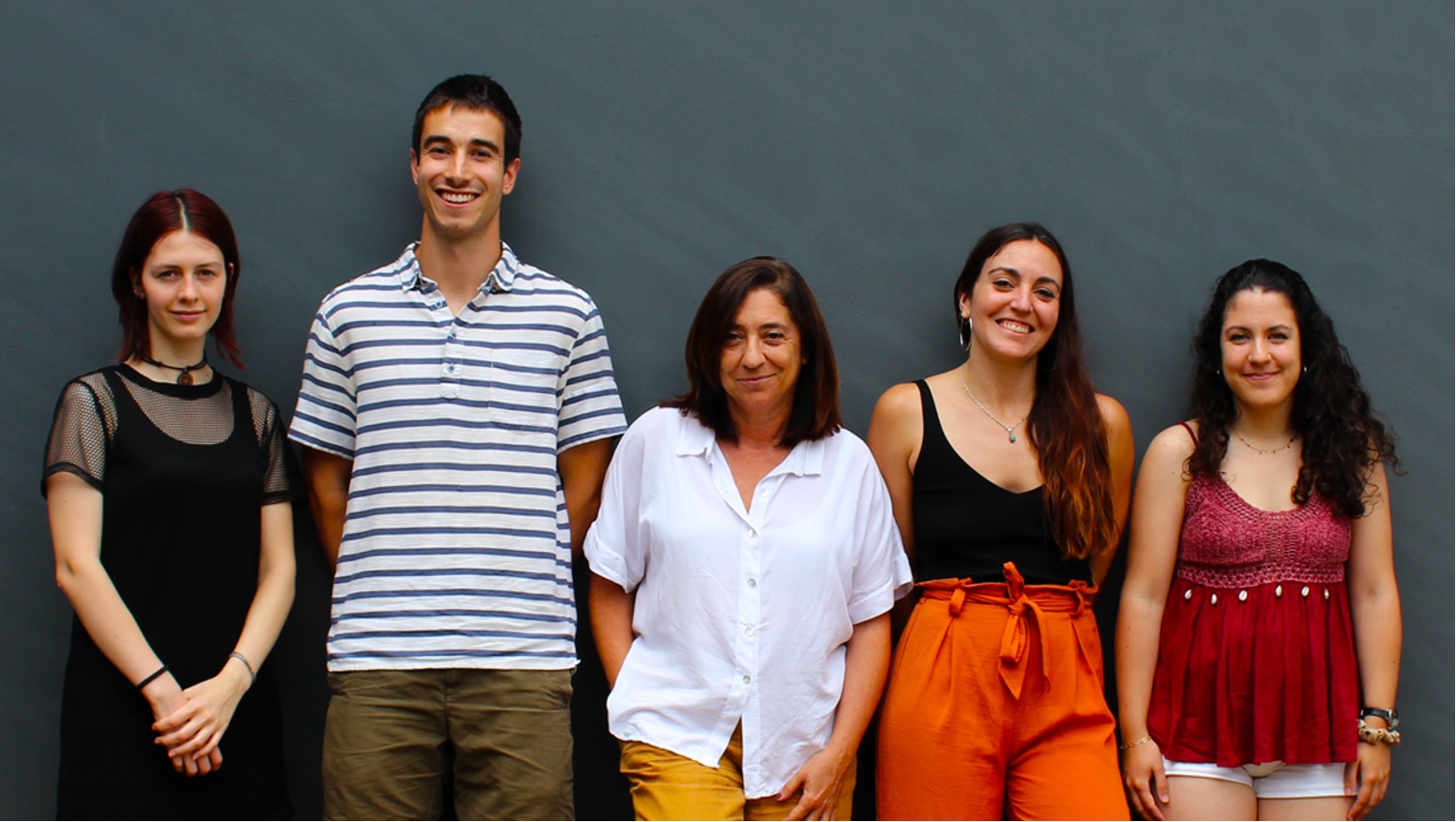
Group photo. De izquierda a derecha, Josephine Hotten, Pablo Guridi, Matxalen Llosa, Dolores Lucía Guzmán-Herrador, Andrea Fernández-Gómez.
El equipo dirigido por Matxalen Llosa, Catedrática de Genética de la Universidad de Cantabria, es uno de los 10 grupos que fundaron en 2007 el Instituto de Biomedicina y Biotecnología de Cantabria (IBBTEC), un Centro Mixto entre la Universidad de Cantabria y el CSIC.
Nuestros intereses científicos se centran en la comunicación bacteriana mediada por los Sistemas de Secreción Tipo IV (T4SS). Estos complejos macromoleculares son capaces de translocar sustratos específicos a través de las membranas de bacterias gram-negativas. Lo que les diferencia de otros sistemas de secreción y les dota de mayor interés es su plasticidad, siendo capaces de secretar tanto proteínas como ADN y complejos nucleoproteicos, tanto al medio extracelular como a otra célula receptora, ya sea procariota o eucariota (Bleves y cols, 2020). Esto se traduce en una enorme versatilidad biológica: los T4SS forman parte de las maquinarias conjugativas para mediar transferencia genética horizontal entre bacterias, están involucrados en la secreción de factores de virulencia a células animales, juegan también un papel en relaciones simbióticas entre bacterias y células de plantas, inyectan toxinas a bacterias competidoras, y son capaces de secretar-importar ADN del medio extracelular. Estas características les convierten en un interesante objeto de estudio tanto desde el punto de vista biológico como biotecnológico y biomédico. Uno de nuestros objetivos es aprovechar su promiscuidad para llegar a virtualmente cualquier tipo celular. Basándonos en el conocimiento molecular que tenemos de estos procesos, pretendemos también utilizar estos sistemas para desarrollar herramientas de introducción de ADN y proteínas en bacterias silvestres de difícil manejo. Como primer paso, estamos ampliando el abanico de bacterias silvestres susceptibles de ser modificadas por conjugación desde E. coli (Fig. 1; Samperio y cols, 2001).
Nuestro trabajo se centra también en descifrar la base molecular del reclutamiento de sustratos. Hace tiempo demostramos que se pueden intercambiar los sustratos entre T4SS involucrados en conjugación y virulencia (Llosa y cols, 2012): complejos nucleoproteicos consistentes en la relaxasa conjugativa covalentemente unida a la hebra de ADN transferido, pueden ser reconocidos y translocados por los T4SS implicados en la virulencia de los patógenos humanos A very significant result of the group has been to show that substrates can be exchanged between T4SS involved in conjugation and virulence. Thus, we have shown that the nucleoprotein complexes that are transferred through the T4SS during bacterial conjugation, consisting of the conjugative relaxase covalently bound to the transferred DNA strand, can be recognized and translocated by the T4SS involved in the virulence of pathogens. humans O Coxiella burnetii (Guzmán-Herrador y cols, 2017). Este resultado se pudo observar con una manipulación mínima de los sistemas naturales, lo que argumenta que posiblemente refleje un fenómeno natural. Nuestro objetivo actual es demostrar si esta transferencia genética en efecto ocurre en la naturaleza, y descubrir el papel biológico que pueda cumplir, bien sea contribuyendo a la virulencia del patógeno que codifica el T4SS, o contribuyendo a posibles relaciones simbióticas del microbioma con su huésped. Con este objetivo, hemos puesto a punto un sistema de detección y análisis de integración de ADN bacteriano en el genoma de células humanas infectadas por bacterias, y estamos estudiando el patrón de integración y el potencial mecanismo subyacente. La capacidad de T4SS de bacterias patógenas de transferir complejos nucleoproteicos abre también la puerta al uso de T4SS para enviar ADN de interés in vivo directamente a las células humanas de elección, que serían distintas dependiendo del tropismo del patógeno de elección. Más aún, hemos visto que el ADN guiado por la relaxasa es más proclive a ser integrado en el genoma receptor (González-Prieto y cols., 2017).
El grupo es también experto en el estudio de relaxasas conjugativas (Guzmán-Herrador y Llosa, 2019). Fuimos pioneros en mostrar que estas proteínas son translocadas a las células receptoras, donde son funcionales y necesarias para concluir el proceso conjugativo (Draper y cols 2005). Estamos analizando en bacterias el conjunto de proteínas que se transfiere por conjugación aparte de la relaxasa, y los requisitos para que estas proteínas se secreten. La vertiente aplicada de esta línea de trabajo consiste en manipular las señales de secreción para customizar la secreción heteróloga (Guzmán-Herrador y cols, 2023). Utilizando las relaxasas conjugativas como drivers para transferir otras proteínas de interés directamente a la célula receptora de la conjugación, hemos enviado nucleasas Cas y editores de bases fusionados a relaxasas conjugativas, y mostramos que estas proteínas de fusión son activas en las células receptoras. Esto permite enviar maquinaria de información genética a cualquier bacteria receptora de conjugación sin necesidad de adaptarla a las señales de expresión de la receptora, y sin el riesgo de sobreexpresar nucleasas que conllevaría actividad off-target y toxicidad (Guzmán-Herrador y cols, 2024).
Por último, una reciente línea de investigación se centra en crear herramientas para monitorizar la transferencia horizontal de plásmidos en entornos naturales. La base es la creación de plásmidos movilizables capaces de almacenar la información de las células que visitan mediante la adquisición de espaciadores en su propio array. Estos plásmidos permitirán seguir la trayectoria de elementos genéticos móviles individuales dentro de mezclas complejas de bacterias en muestras naturales, lo que aportará valiosa información sobre la diseminación de plásmidos en la naturaleza, incluyendo la información que codifican, como resistencias a antibióticos.
Our scientific interests focus on bacterial communication mediated by Type IV Secretion Systems (T4SS). These macromolecular complexes, like other families of secretion systems, are capable of translocating specific substrates across the membranes of gram-negative bacteria. What differentiates them from other systems and endows them with greater interest is their plasticity, being capable of secreting proteins as well as DNA and nucleoprotein complexes, both to the extracellular medium and to another recipient cell, whether prokaryotic or eukaryotic. This translates into an enormous biological versatility: the T4SS are part of the conjugative machinery to mediate horizontal gene transfer between bacteria, they are involved in the secretion of virulence factors to animal cells, they also play a role in symbiotic relationships between bacteria and animal cells. plants, inject toxins into competing bacteria, and are capable of secreting-importing DNA from the extracellular medium. These characteristics make them an interesting object of study from a biological, biotechnological and biomedical point of view. Based on the molecular knowledge we have of these processes, our group also intends to use these systems to develop tools for the introduction and site-specific integration of DNA in human cells.
A part of our work focuses on the comparative study of T4SS belonging to conjugative systems and pathogenic bacteria. Our study models are the T4SS of the conjugative plasmid R388, and the T4SS VirB/D4 of A part of our work focuses on the comparative study of T4SS belonging to conjugative systems and pathogenic bacteria. Our study models are the T4SS of the conjugative plasmid R388, and the T4SS VirB/D4 ofA part of our work focuses on the comparative study of T4SS belonging to conjugative systems and pathogenic bacteria. Our study models are the T4SS of the conjugative plasmid R388, and the T4SS VirB/D4 of
A very significant result of the group has been to show that substrates can be exchanged between T4SS involved in conjugation and virulence. Thus, we have shown that the nucleoprotein complexes that are transferred through the T4SS during bacterial conjugation, consisting of the conjugative relaxase covalently bound to the transferred DNA strand, can be recognized and translocated by the T4SS involved in the virulence of pathogens. humans A very significant result of the group has been to show that substrates can be exchanged between T4SS involved in conjugation and virulence. Thus, we have shown that the nucleoprotein complexes that are transferred through the T4SS during bacterial conjugation, consisting of the conjugative relaxase covalently bound to the transferred DNA strand, can be recognized and translocated by the T4SS involved in the virulence of pathogens. humans O A very significant result of the group has been to show that substrates can be exchanged between T4SS involved in conjugation and virulence. Thus, we have shown that the nucleoprotein complexes that are transferred through the T4SS during bacterial conjugation, consisting of the conjugative relaxase covalently bound to the transferred DNA strand, can be recognized and translocated by the T4SS involved in the virulence of pathogens. humans A very significant result of the group has been to show that substrates can be exchanged between T4SS involved in conjugation and virulence. Thus, we have shown that the nucleoprotein complexes that are transferred through the T4SS during bacterial conjugation, consisting of the conjugative relaxase covalently bound to the transferred DNA strand, can be recognized and translocated by the T4SS involved in the virulence of pathogens. humans
This result could be observed with little or no manipulation of natural systems, arguing that it possibly reflects a natural phenomenon, and horizontal DNA transfer between pathogens and their host cells, mediated by T4SS, may occur. Our current goal is to demonstrate whether this gene transfer does indeed occur in nature, and to discover the biological role it may play, either by contributing to the virulence of the pathogen encoded by T4SS, or by contributing to possible symbiotic relationships of the microbiome with its host.
The applied aspect of this line consists of manipulating the T4SS of different pathogenic bacteria so that they secrete DNA molecules of interest in vivo directly to the human cells of choice, which would be different depending on the tropism of the pathogen of choice.
Another line of work focuses on the characterization of conjugative relaxases, the proteins that process and guide DNA to the recipient cell during conjugation. Our model is the relaxase of the conjugative system of R388, TrwC. This protein, in addition to its role in conjugation, has site-specific recombinase and integrase activity in the recipient bacteria, an activity that we have characterized in bacteria and are testing in human cells. One of our challenges is to elucidate what would be the biological role of this unexpected activity, which curiously is shared by some, but not all conjugative relaxases analyzed. Our data indicate that, although the protein initiates recombination/integration reactions with high sequence specificity for its specific target, the targeting in the recipient cell is more lax. This leads us to think that such a system could provide the conjugative plasmid with a colonization system for non-permissive hosts (i.e. bacteria to which the plasmid can conjugate, but where it could not replicate), promoting its integration into the recipient genome.
By fine-tuning the T4SS DNA transfer assay of human pathogens, we have also studied the activity of TrwC and other relaxases after being transferred into human cells, discovering that relaxase enhances integration into cells by two orders of magnitude. the human genome of DNA transferred from the bacterium. This integration is not site-specific, although we are developing different strategies to make it so. Although we are still in the proof-of-concept stage, the potential applications are enormous.
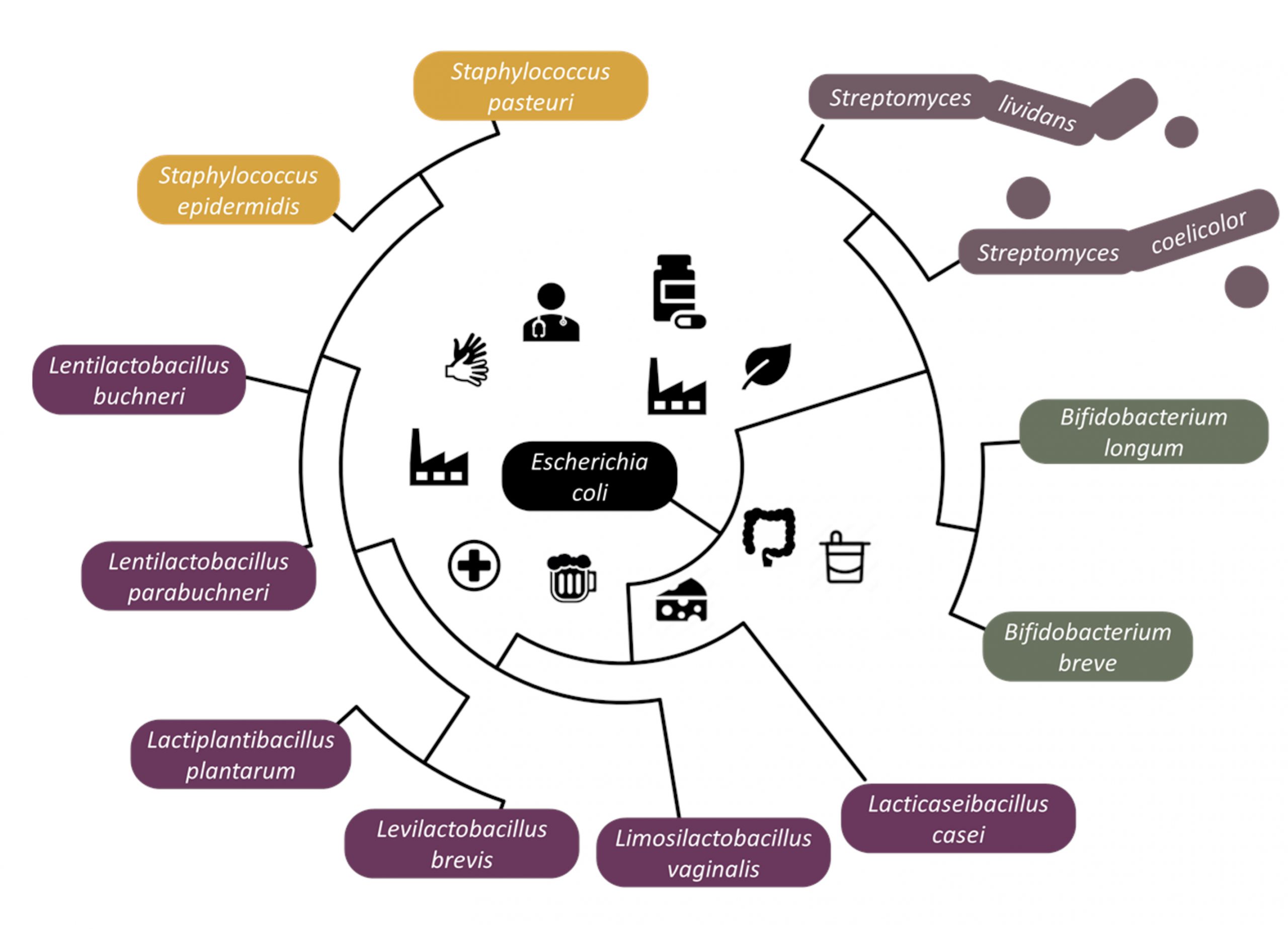
Figure. Gram-positive bacteria of biotechnological and biomedical interest that we have modified by conjugation since E. coli
References cited
-
- Bleves S, Galán J, Llosa M* (2020). Bacterial injection machines: evolutionary diverse but functionally convergent. Cell Microbiol. 22(5):e13157. doi: 10.1111/cmi.13157
- Draper O, César CE, Machón C, de la Cruz F, Llosa M* (2005). Site-specific recombinase and integrase activities of a conjugative relaxase in the recipient cell. Proc Natl Acad Sci USA 102: 16385-16390
- González-Prieto C, Gabriel R, Dehio C, Schmidt M, LlosaM* (2017). The Conjugative Relaxase TrwC Promotes Integration of Foreign DNA in the Human Genome.
Appl Environ Microbiol. 83:e00207-17. doi: 10.1128/AEM.00207-17. - Guzmán-Herrador DL, Llosa M* (2019). The secret life of conjugative relaxases. Plasmid 104:102415. https://doi.org/10.1016/j.plasmid.2019.102415
- Guzmán-Herrador DL, Fernández-Gómez A, Llosa M* (2023). Recruitment of heterologous substrates by bacterial secretion systems for transkingdom translocation. Front Cell Infect Microbiol. 13:1146000. doi: 10.3389/fcimb.2023.1146000.
- Guzmán-Herrador DL, Fernández-Gómez A, Depardieu F, Bikard D*, Llosa M* (2024). In vivo delivery of functional Cas:DNA nucleoprotein complexes into recipient bacteria through a Type IV Secretion System. Natl. Acad. Sci. USA 121(43):e2408509121. doi: 10.1073/pnas.2408509121
- Llosa M, Schröder G, Dehio C (2012). New perspectives into bacterial DNA transfer to human cells. Trends Microbiol 20(8): 355-359
- Samperio S, Guzmán-Herrador DL, May-Cuz R, Martín MC, Álvarez MA, Llosa M* (2021). Conjugative DNA Transfer from colito Transformation-Resistant Lactobacilli. Front Microbiol. 12:606629. doi: 10.3389/fmicb.2021.606629.